
Research results: energy | hydronic balancing of heating

Updated: Feb 4
Table of contents Energy

The feasibility study by consultancy firm Steeds Advies BV
does state that the current heating system is largely functioning properly;
but also that heat loss and pressure differences in the pipes can lead to an uneven distribution of heat within the building.
The current situation
Kleiburg uses district heating, with a collective boiler, risers and radiators and/or underfloor heating per apartment.
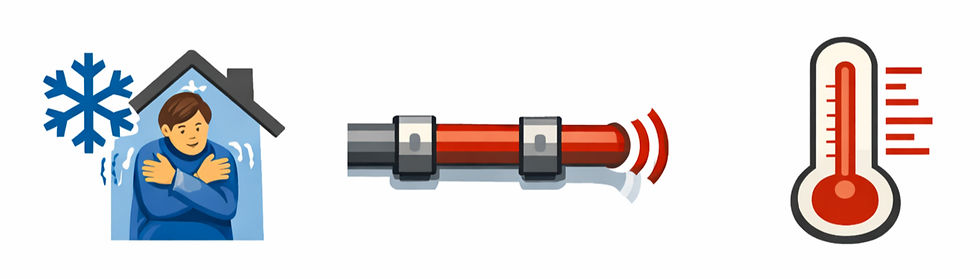
The difference in heating demand between the lower and upper floors compared to end-of-terrace and mid-terrace homes can be significant. This often leads to overloaded heating systems near the boiler and insufficient heating systems further away, leading to complaints such as:
too cold corner houses;
noise in pipes;
and unnecessarily high return temperatures.
Without proper regulation, excessive amounts of hot water often circulate through risers and corridors, even when relatively little heat is needed. This causes unnecessary heat to remain in the shafts and corridors.
Opportunity for improvement
Not recommended by Steeds Advies, but RVO and the National Heat Fund mention hydronic balancing as an energy-saving measure.
What is hydronic balancing?
Hydronic balancing is a way to adjust the heating system so that the water flows automatically adapt to the actual heat demand. For this purpose, dynamic balancing valves are installed in the risers and in each radiator/underfloor heating loop. These valves automatically limit the flow rate and compensate for pressure fluctuations.
In an apartment building like Kleiburg with 10 risers, this ensures that:
each riser and each radiator/loop gets its “own” maximum water flow;
pressure differences between above and below are automatically compensated;
an equal temperature difference between supply and return water can be achieved everywhere, so that the water in all apartments gives off the same heat.
Dynamic valves are specifically suitable for apartments with block and district heating, precisely because residents operate their heating independently of each other and pressure fluctuations can therefore be large.
In homeowners' associations (VvE) buildings, the flow is limited per riser and per radiator/heating loop. This reduces transport losses in the risers and ensures a more equitable heat distribution. Hydronic balancing reduces heat loss in pipes through lower flow rates, smaller total volume flows, and decreasing water temperatures in the network.

What does it yield?
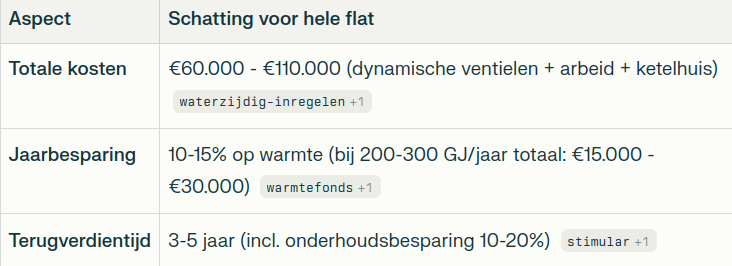
In an apartment building like Kleiburg phase 1 (110 apartments, high-rise building, 1970s, block heating and heat network), dynamic adjustment can lead to 12-15% savings on total heat consumption, especially because
the return water temperature decreases;
dynamic valves absorb pressure fluctuations;
boiler and pump run more quietly.
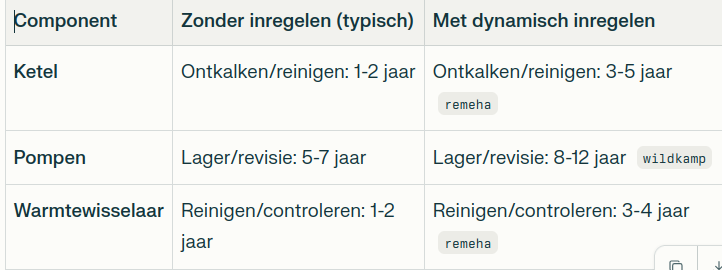
Hydronic balancing extends maintenance intervals for boilers, pumps and heat exchangers by reducing stress and wear.
Hydronic balancing can extend the actual lifespan of existing risers and reduce the occurrence of leaks and blockages caused by magnetite/sludge.
The adjustment
reduces the total volume flow and dampens pressure fluctuations → less erosion and less cavitation in bends, T-pieces and constrictions;
allows the system to run more quietly (less “ramming” of pumps) → less mechanical stress on pipes, couplings and accessories;
ensures a lower average temperature in return and often also in supply → less thermal load, which somewhat slows down the rate of corrosion at high temperatures.
In addition, comfort improves: rooms heat up more evenly, extreme temperature differences disappear and flow noise in radiators is significantly reduced.
Costs and payback period
For a block of 110 apartments, the costs are roughly estimated at around €60,000–€110,000 and a payback period of 3 to 5 years.
Why these bandwidths?
Costs
For an apartment building with 110 apartments, the costs depend on:
number of radiators per home (and/or underfloor heating groups);
whether or not to replace existing taps with dynamic valves;
yes/no additional pressure differential regulators, pumps, adjustment work in the boiler house;
accessibility, planning (e.g. working by grid/rise), and regional labor costs.
However, if the Ferroli heat exchangers are simultaneously replaced with a 2026 model, 100% of the adjustment can be done centrally, eliminating the first two considerations. This reduces costs by 40 to 50%.
Payback period (TPR)
Higher savings with a heating network and poor current system: closer to 3 years;
Longer TVT with good existing regulation or a lot of underfloor heating: up to 5 years.
Subsidy and loan
Subsidies for hydronic adjustment are provided through the SVVE scheme (for homeowners' associations)
but only in combination with one or more energy-saving insulation measures and/or sustainable heating options;
the subsidy amounts to €90 per apartment.
The hydronic adjustment can also be further financed by a loan from the National Heat Fund.
[Read all about saving, borrowing and subsidies here ]
Marginal note
Under certain conditions, it is possible to finance the replacement of heat exchangers simultaneously with hydronic balancing through the National Heat Fund. To qualify, the replacement must be recognized as an energy-saving measure and be stated as such in the quotation.
In practice, this means that if replacing heat exchangers clearly contributes to improving heat output, energy efficiency, and comfort, and this is explicitly described as part of the measure in the quotation, it can be co-financed. However, this must be requested clearly and specifically in advance and approved by the Heat Fund.
Read more about Energy?
Do you have any questions, ideas or would you like to share your experiences?
Email us at duurzaamkleiburg1@gmail.com . Together we'll chart a path toward a future-proof Kleiburg.


