Sustainability costs money

Updated: Feb 9
Making Kleiburg phase 1 more sustainable will cost. As a homeowners' association, we have to make choices: how far do we want to go and how will we pay for it? Energy savings and improved living comfort are the benefits, but the investments are substantial. The main options are: saving , borrowing , and, where possible, utilizing subsidies . Subsidies cover on average 15–30% of the costs. The remainder must come from our own resources and/or loans.
This article lists the options and their advantages and disadvantages.
How do we pay for the sustainability of the apartment building?
Reducing energy consumption and improving living comfort requires investment. The amount depends on the measures chosen. As with any investment, the question is: what does it cost and what is the return?
Financing can be done in three ways
Save;
To borrow;
Make use of subsidies.
Because subsidies never cover all costs, it is important to first look at savings and borrowing.
Save or borrow?
We can finance large expenses in various ways:
Save until we have enough cash;
Accelerated savings through monthly contributions to be significantly increased;
One-off contributions to the VvE reserve fund;
Borrowing through a joint VvE loan.

Advantages and disadvantages side by side
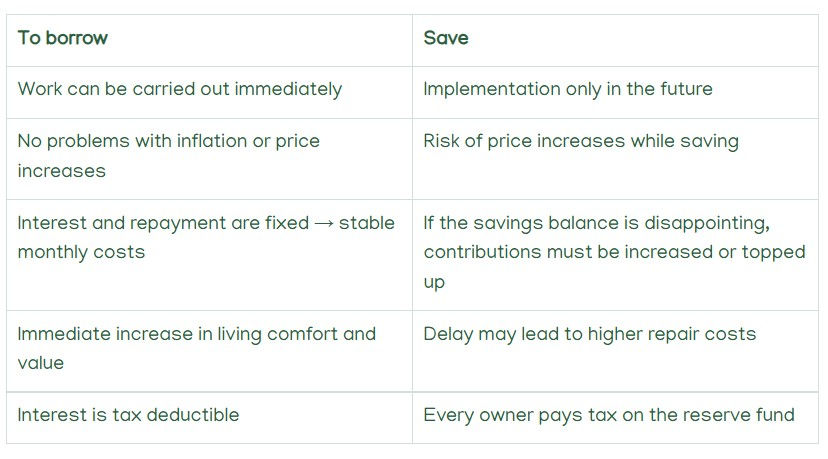
To borrow

If, as a homeowners' association, we choose to (partially) finance the sustainability plans of our building (only the common areas) with a loan, this can only be done with a resolution of the AGM (general members' meeting) with a qualified majority.
Borrowing, option 1: from the National Heat Fund
The National Heat Fund and the Homeowners' Association Energy Saving Loan - The Heat Fund, commissioned by the National Government, offers loans for more than 30 energy measures.
The following applies:
No closing costs;
Members pay interest and principal through the monthly contribution;
The interest rate is more favorable and remains fixed for the entire term (10–30 years). In July 2025: 3.29% (10 years) to 3.71% (30 years);
Money goes into a construction fund; invoices are paid from it;
Early repayment up to 20% per year without penalty.
The Heat Fund does impose requirements on the quality and effectiveness of the sustainability measures to be implemented. And also:
Have a customized VvE energy advice drawn up and update or create a current multi-year maintenance plan (MJOP);
Possible restrictions on rented apartments, shops or commercial spaces.
Everything can be found here: https://warmtefonds.nl/vve
The research results pages will indicate for each proposed measure whether it meets the conditions for the VvE Energy Saving Loan.
The National Heat Fund and the VvE Member Loan - an additional option for owners (who also occupy the apartment) with a low income. If the VvE finances the sustainability improvements with the VvE Energy Saving Loan, the contribution you must pay to the VvE will increase. If this is difficult for you due to a low income, you can apply for a Member Loan as a member of that VvE. This is:
intended for owners who occupy their apartments themselves.
interest-free and only needs to be repaid when the apartment is sold.
However, maximum income limits apply to this loan. Owner -occupiers must apply for this loan themselves. For more information, see here.
Borrowing, option 2: from the Future-proof maintenance fund for homeowners' associations
This route is an alternative for possible measures that are not financed by the Heat Fund;
The interest rate is higher: in autumn 2025 around 5.8% for 20 years;
Advantages and disadvantages need to be further investigated.
Subsidies - RVO
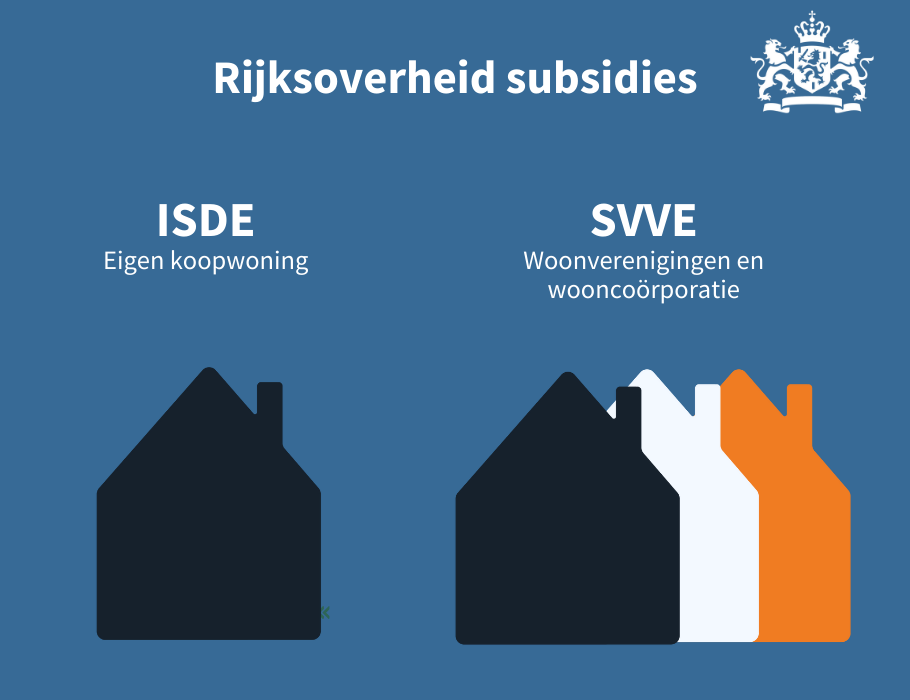
The central government offers subsidies through the RVO (Netherlands Enterprise Agency) for:
Research and advice : up to 50% reimbursement, max. € 40,000 ;
Construction supervision : 50% reimbursement, max. € 20,000 - Construction supervision means that a construction supervisor monitors the quality of the project management and the construction itself ;
The Sustainability Measures : fixed amounts per m² or per piece;
For one measure: an average of 15% of the costs;
For two or more measures: average 30% of the costs;
Please note: some packages such as ZEP (very energy efficient package) impose additional requirements that are not profitable for Kleiburg.
The percentages mentioned are from the Ministry of the Interior and Kingdom Relations (BZK). Read all about it at here.
Several committee members also attended the webinar below . We highly recommend listening, provided you can set aside an hour for it.
Subsidy - the Municipality of Amsterdam

Amsterdam offers several subsidy options for sustainability, but Kleiburg does not meet the requirements in most cases:
These include that the measures will ensure that all homes in the building achieve at least 3 label steps .
Because a number of improvements have already been made during the renovation in 2013, it is practically impossible for us to meet this condition.
Of possible interest to us is the subsidy for sustainability planning for homeowners' associations.
This subsidy is awarded for
having a number of construction technical studies carried out, such as asbestos research, thermal bridge calculations, flora and fauna research;
activities related to obtaining permits, applying for subsidies, construction cost estimates;
preparation and guidance of the decision-making process.
For the Amsterdam City Council's planning subsidy, a contractor is required to develop a plan in advance that addresses the above components. Again, it's not possible to apply for the subsidy in installments.
Next step
In our publications on possible measures for Kleiburg, the committee will indicate for each measure whether it is eligible for a subsidy and/or loan;
On this basis, the VvE can make choices that suit our financial situation and ambitions.
Do you have any questions, ideas or would you like to share your experiences?
Email us at duurzaamkleiburg1@gmail.com . Together we'll chart a path toward a future-proof Kleiburg.